
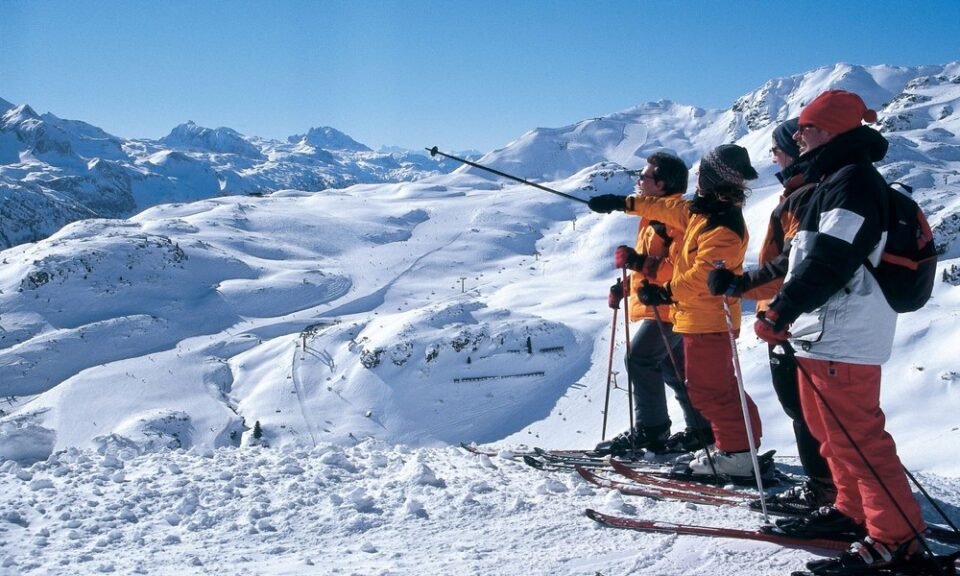
Two of France’s most celebrated ski resorts and luxury chalet val d isere. Both world-class. Both wildly different. If you’re trying to decide between Val d’Isère and Val Thorens for your next ski holiday, this guide breaks down everything you need to know, terrain, snow, atmosphere, après-ski, and more.
The Basics
Val d’Isère sits at 1,850m in the Savoie department of the French Alps, at the head of the Tarentaise valley. Together with neighbouring Tignes, it forms the Espace Killy ski area: 300km of marked runs across more than 150 pistes. The resort has been hosting elite ski racing since the 1992 Albertville Winter Olympics.
Val Thorens sits at 2,300m – the highest ski resort in Europe, in the Three Valleys, the world’s largest linked ski area with over 600km of runs connecting Méribel, Courchevel, Les Menuires, St Martin de Belleville, and more. Its extraordinary altitude means it typically has the best and most reliable snow conditions of any major French resort.
Snow Reliability
This is Val Thorens’ great advantage. At 2,300m base altitude, the resort frequently skis from November through to May. Even in poor snow years, and they do happen, Val Thorens’ glacier skiing and north-facing aspects keep conditions workable when lower resorts are struggling. If you’re booking a March or April trip, this matters enormously.
Val d’Isère is no slouch on snow. It has its own glacier (the Pisaillas glacier on the Grande Motte side via Tignes) and plenty of high-altitude terrain that holds snow well. But it sits about 450m lower than Val Thorens at base, and in a warm winter, lower runs can thin out by late March.
Winner: Val Thorens – for snow reliability, especially outside peak season.
Ski Area and Terrain
Val d’Isère / Espace Killy (300km combined with Tignes):
- Strong bias towards intermediate and expert skiers
- Excellent mogul fields and off-piste routes
- Bellevarde face is legendary (it hosted Olympic downhill racing)
- Good nursery slopes in the village at La Daille
- Linked to Tignes, which adds more varied terrain including the Grande Motte glacier
The Espace Killy is genuinely thrilling for confident skiers. Wide open powder bowls above the treeline, long vertical descents, and accessible off-piste from every lift. Beginners will find some gentler terrain, but the character of the resort leans towards the more adventurous.
Val Thorens / Three Valleys (600km+ combined):
- Part of the world’s largest linked ski area
- Terrain ranges from wide motorway blues to serious black runs and off-piste
- Excellent for groups of mixed ability the Three Valleys has something for literally everyone
- Val Thorens itself is compact and easy to navigate
- You can ski to Méribel and Courchevel from Val Thorens in a day
The Three Valleys connectivity is the key selling point. You could ski a different area every day for two weeks without repeating yourself. For groups with mixed ability, the breadth of terrain options is unmatched.
Winner: Val Thorens for sheer scale and variety; Val d’Isère for a more characterful, cohesive ski area.
Village Atmosphere
These two resorts couldn’t feel more different on the ground.
Val d’Isère is a proper alpine village. It has a church, a central square (La Place), a river running through it, and real trees. It’s been a farming community and trading post since medieval times, and despite significant resort development, it retains genuine character. The main street has a good selection of independent shops, restaurants, and bars, and the whole place feels lively without being overwhelmingly brash.
The resort has a well-earned reputation for sophistication. There are excellent restaurants ranging from traditional Savoyard to genuinely inventive modern cuisine. The après-ski is legendary, Café Face and Bar Jacques are institutions, but it doesn’t overwhelm the rest of the experience.
Val Thorens is the opposite: a purpose-built, high-altitude resort that didn’t exist before the 1970s. It’s functional rather than beautiful. The architecture is classic French 1970s ski-resort concrete think apartment blocks and covered walkways and it lacks the charm of an older alpine village. However, it’s incredibly convenient. Everything is ski-in/ski-out. There are no roads to cross, and the compact layout means you’re never far from a lift.
If atmosphere and aesthetic charm matter to you, Val d’Isère wins decisively. If pure ski convenience is the priority, Val Thorens is hard to beat.
Winner: Val d’Isère – by a significant margin for village character and atmosphere.
Après-Ski
Both resorts have strong après-ski scenes, but they’re different in character.
Val d’Isère has the better all-round evening scene. The après-ski is lively without being chaotic, there’s a genuine restaurant culture, and you can have a very good night out or a very civilised dinner depending on your preference. The mix of British, French, and international guests creates a good atmosphere across the week.
Val Thorens leans harder into the party atmosphere, particularly among younger crowds. It has a reputation as one of the more hedonistic French resorts. The VTown Tuesdays events and regular DJs in resort bars mean there’s always something going on. If you want to dance until 3am and ski hungover, Val Thorens accommodates.
Winner: Val d’Isère for broader appeal; Val Thorens for those who prioritise nightlife.
Catered Chalets
Both resorts have strong catered chalet offerings, though the style differs.
In Val d’Isère, chalets tend to be more traditional in build, often converted farmhouses or alpine properties with wooden beams, open fireplaces, and genuine character. The village’s more spread-out layout means some chalets require a short walk or shuttle to the main lifts, though many are genuinely ski-in/ski-out.
In Val Thorens, the compact resort design means most chalets and chalet-style apartments are genuinely ski-in/ski-out, which is a practical advantage. The properties themselves tend to be within larger buildings rather than standalone chalets, but this doesn’t diminish the catered chalet experience.
Getting There
Both resorts are typically accessed via Geneva Airport (GVA), though Lyon (LYS) and Chambéry (CMF) are also options.
- Val d’Isère: approximately 2.5-3 hours from Geneva by road transfer
- Val Thorens: approximately 2-2.5 hours from Geneva, slightly shorter via Chambéry
Neither resort is accessible by train directly. Most visitors use shared or private road transfers. Note that the road to Val d’Isère (via Bourg-Saint-Maurice) can occasionally be closed due to avalanche risk, particularly during heavy snowfall periods, a very occasional inconvenience.
Who Should Go Where?
Choose Val d’Isère if you:
- Are an intermediate to advanced skier looking for challenge
- Value atmosphere, village character, and a strong restaurant scene
- Want a resort that feels like a real alpine community
- Are doing a once-in-a-lifetime ski trip and want the “classic” experience
Choose Val Thorens if you:
- Prioritise snow reliability above all else, especially for late-season trips
- Want maximum terrain variety with access to the Three Valleys
- Are part of a large group with very mixed abilities
- Want the convenience of genuine ski-in/ski-out access everywhere
The Verdict
There is no objectively better resort, only the better resort for you. Val d’Isère is one of the most beautiful and celebrated ski destinations in the world, with a personality and history that Val Thorens simply cannot match. But Val Thorens’ altitude, snow reliability, and connection to the Three Valleys make it the more practical choice for many skiers, particularly those booking outside the Christmas-February peak.
Many seasoned ski travellers do both over the course of their skiing lives and most come away thinking they were completely different, equally memorable experiences.
